If you grew up somewhere with an annual inspection sticker, you remember the rhythm. A month came around, you dropped the car off, and you left with either a new sticker or a list of what had to be fixed first. Move to Lexington and that rhythm just stops. No sticker on the windshield. No letter in the mail. Nothing in your registration renewal that mentions the condition of your car.
That is not an oversight. South Carolina got rid of its mandatory annual safety inspection in 1995, and most of the country has since done the same. As of 2019, only 15 states still required an inspection of any kind, down from a peak of 31 in the early 1980s. If you are hunting for a South Carolina vehicle inspection deadline, there isn’t one to find.
Here is what matters. The requirement went away. The wear did not. What changed is who is responsible for noticing. Below is a practical car maintenance checklist Lexington SC drivers can work through at home, plus a rhythm to replace the deadline the state no longer hands you.
What the South Carolina vehicle inspection repeal actually changed in 1995
Before the repeal, every registered vehicle went in front of a technician once a year whether the owner thought it needed it or not. That was the real value of the program, not the sticker. It put a set of eyes on the car on a fixed calendar, including the cars whose owners would never have booked anything on their own.
Since the mandate ended, South Carolina has stayed in the upper tier of states for fatal crashes, recording 988 fatal wrecks in 2017, the 13th highest total in the country. Nobody can say how many involved a vehicle that would have failed an inspection, and we will not pretend otherwise. What we see in our own bays is simpler. Cars roll in from Lexington, West Columbia, Cayce, Irmo, and Chapin carrying problems that had been building for years, and the owner never had a reason to look.
The timing matters. The average light vehicle on American roads hit a record 12.8 years old in 2025, with passenger cars averaging 14.5 years. The fleet on I-20 and US-378 today is older than the one the legislature was looking at in 1995.
No inspection is not the same as no standard
This is the part most articles about state inspections skip. South Carolina did not decide your car is allowed to be unsafe. It only stopped checking on a schedule.
Section 56-5-4410 still makes it unlawful to drive a vehicle that is “in such an unsafe condition as to endanger any person or property,” or that is not “at all times equipped with lights, brakes, steering and other equipment in proper condition and adjustment.” Look at that phrase again: at all times. Your car has to meet that standard every day it is on the road, and an officer working US-1 or Highway 378 can enforce it whenever they like.
The equipment sections read like a checklist written for exactly this purpose:
- Tires must be “in a safe operating condition” (56-5-5040).
- Brakes must be adequate “to stop and hold such vehicle under all conditions of loading,” plus a parking brake that holds the car on a grade (56-5-4850).
- Windshield wipers must be “maintained in good working order” (56-5-5000).
- The muffler must be in good working order and constant operation, with the engine adjusted to prevent excessive fumes and smoke (56-5-5020).
- Lamps must be lit from a half hour after sunset to a half hour before sunrise, and any time your wipers are running in rain, sleet, or snow (56-5-4450). The rear plate must be lit well enough to read from 50 feet back (56-5-4530).
The standard is in writing. What the state took away was the appointment. Without one, the first thing that checks your car is a traffic stop, a rainy afternoon on I-26, or a wreck. Your dashboard is the one automatic warning left, which is why a check engine light deserves attention here instead of months of driving on it.
Tires: tread, pressure, and the date code nobody reads
First stop on any car maintenance checklist Lexington SC drivers run themselves: the tires. About 33,000 tire-related passenger vehicle crashes happen in the United States every year, causing roughly 19,000 injuries.
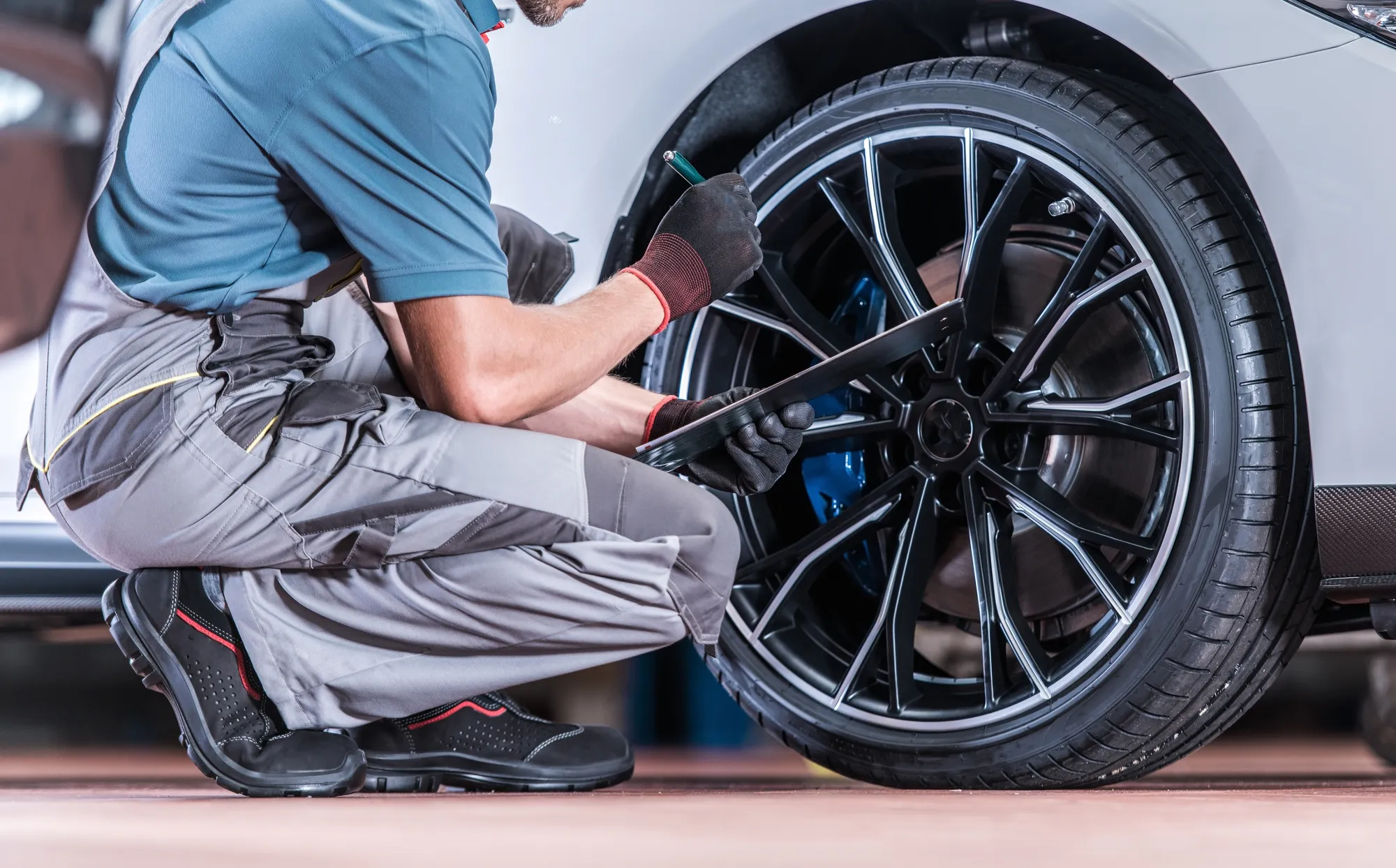
Tread. NHTSA’s guidance is to think about replacing any tire once tread falls below 4/32 of an inch, and to stay off any tire at 2/32 or less, because that is where grip in wet weather falls apart. Among tires worn to 2/32 or below, about 26 percent were on vehicles that had a tire problem in the moments before a crash, against only 8 percent of tires in the 3/32 to 4/32 range. That cliff arrives long before a tire looks bald. A penny in the groove with Lincoln’s head pointed down is still the fastest check going: see the top of his head and that tire is done. Check whether the wear is even across the face too, because uneven tire wear patterns usually mean something else on the car wants attention.
Pressure. Check it monthly, cold, against the sticker on the driver’s door jamb, not the number molded into the sidewall. Do not wait on the dashboard light: by the time it triggers, at least one tire is already badly underinflated. Federal data shows tires underinflated by 25 percent or more are about three times as likely to be cited as the critical event in a crash. Midlands heat swings pressure more than people expect, and a tire that was right in March may not be right in August.
Age. This is the one a tread check will never catch. Tire manufacturers generally recommend a professional inspection once a year after five years of use, and nearly all say to replace any tire more than ten years old as a precaution, even when the tread still looks fine. Rubber degrades with heat, sun, and time whether the car is driven daily or parked at Lake Murray all summer. The four-digit code at the end of the DOT stamp is the week and year that tire was built. A 2015 date code under good-looking tread is still a conversation worth having.
AAA found roughly 63 percent of drivers never rotate their tires or check tread depth, and 56 percent never check pressure. Doing any of this puts you in a small minority.
Brakes: what you can hear, feel, and see
You cannot measure pad thickness in a parking lot, but brakes will tell you plenty before it gets that far:
- A high, steady squeal at low speed is usually the wear indicator doing its job.
- Grinding is metal on metal, and it means the pad material is gone.
- A pedal that sinks, or travels farther than it used to, points at fluid, a leak, or air in the system.
- Pulling to one side under braking suggests a sticking caliper or uneven wear.
- Pulsing through the pedal or the steering wheel usually means an uneven rotor surface.
Anything on that list is worth a phone call, and we have a fuller guide to what a squeak, a grind, or a soft pedal is telling you. Watch for the silent case too: pads can get thin without ever squealing, so a driver who never has the wheels off gets no warning at all.
Lights, wipers, and glass: the two-minute walk-around
This is what a mandated inspection used to handle, and the easiest thing here to do yourself. Park facing a storefront window at dusk, or grab someone to stand behind the car:
- Headlights on low and high beam, plus fog lamps if you have them.
- Tail lights, then brake lights with a helper watching, including the third one.
- Turn signals front and rear, the hazards, and the reverse lights.
- The license plate lamp, which is required and is invisible from the driver’s seat.
- Wiper blades: streaking, chattering, torn edges, or a rubber lip gone hard. A Midlands summer of heat and pollen ruins blades, and they fail right as the fall rain shows up.
- Washer fluid, and windshield chips, which spread fast with our temperature swings.
One more thing about that lamp rule: it works alongside your wipers. If it is raining hard enough for the wipers, your lights are supposed to be on.
Fluids, belts, and what the driveway tells you
Pop the hood monthly, engine cool, car on level ground:
- Engine oil on the dipstick, checking level along with how dark or gritty it looks.
- Coolant at the reservoir, between the marks, and never with a hot cap.
- Brake fluid level, since a dropping level means either worn pads or a leak.
- Power steering and transmission fluid where your vehicle lets you check them.
- Belts and hoses for cracking, glazing, fraying, or a hose that feels spongy.
- The driveway where you park. Clear water in a Lexington summer is usually A/C condensate. Anything colored or slick is not.
Steering, suspension, and exhaust: the parts you cannot see
Some items need a lift. From the driver’s seat, watch for a steering wheel that wanders or has slop in the middle, clunks over the patched pavement and railroad crossings around downtown Lexington, a car that keeps bouncing after a dip, or a nose that dives hard under braking. A rasping muffler is the other one, and it is both a legal problem under the state code and a safety problem, since a leak in the wrong place can put fumes in the cabin.
Ready to have somebody else look?
If nobody has been under your car in a few years, that is a normal place to be in a state that stopped asking. Schedule an appointment at our Lexington shop and we will go over the whole vehicle with you.
A self-scheduled rhythm for a state with no legal reminder
Attach the check to something that already happens, since the calendar will not do it for you:
- Monthly: tire pressure, a lap around the car for lights, a look at wiper blades and fluid levels. Ten minutes.
- Every oil change: have the shop look at tires, brakes, belts, hoses, and leaks while the car is already in the air. Highest-value habit here.
- Once a year: a full inspection, wheels off, on a lift. This is the appointment that replaces the sticker.
- Seasonally: before the worst of the Midlands heat, and again before the fall rain.
- Before a long trip: tires, including the spare, plus brakes and fluids.
Pick a month and make it yours. Birthday month, tax month, whatever sticks.
When a check turns into auto repair in Lexington, SC
Sometimes a self-check turns up something real, and the next question is what it takes to fix. We do not publish numbers here on purpose. Parts and labor pricing moves, and a stale figure is worse than none. Tell us the vehicle and what you found, and we will give you a current, specific answer through our Get a Quote page or over the phone. One pattern holds: things found early on a lift are almost always smaller jobs than the same things found later on the shoulder of the road.
Frequently asked questions
Does South Carolina require a yearly car inspection?
No. The mandatory annual safety inspection was eliminated in 1995, and there is no sticker or state deadline for a passenger vehicle today.
Can I still be ticketed for a bad tire or a burned-out light?
Yes. State law requires tires in safe operating condition, working brakes and wipers, and functioning lamps at all times. No inspection program does not mean no enforcement.
What if I just moved to Lexington from a state with inspections?
Assume the clock is running from your last real inspection. If that was over a year ago, a whole-vehicle check is a reasonable first appointment here.
Where can I get this done near me in the Midlands?
Our shop is in Lexington, and we see customers from West Columbia, Cayce, Irmo, Chapin, Gilbert, and Batesburg-Leesville.
Book your own inspection, since the state won’t schedule it
South Carolina handed the calendar to you, which is not a bad deal as long as somebody writes the date down. For auto repair Lexington SC drivers can plan around instead of react to, our team will put your vehicle on a lift, walk you through what we find, and say plainly what needs attention now and what can wait.
Schedule an appointment with our Lexington shop and get your car back on a schedule, since the state no longer keeps one for you.