
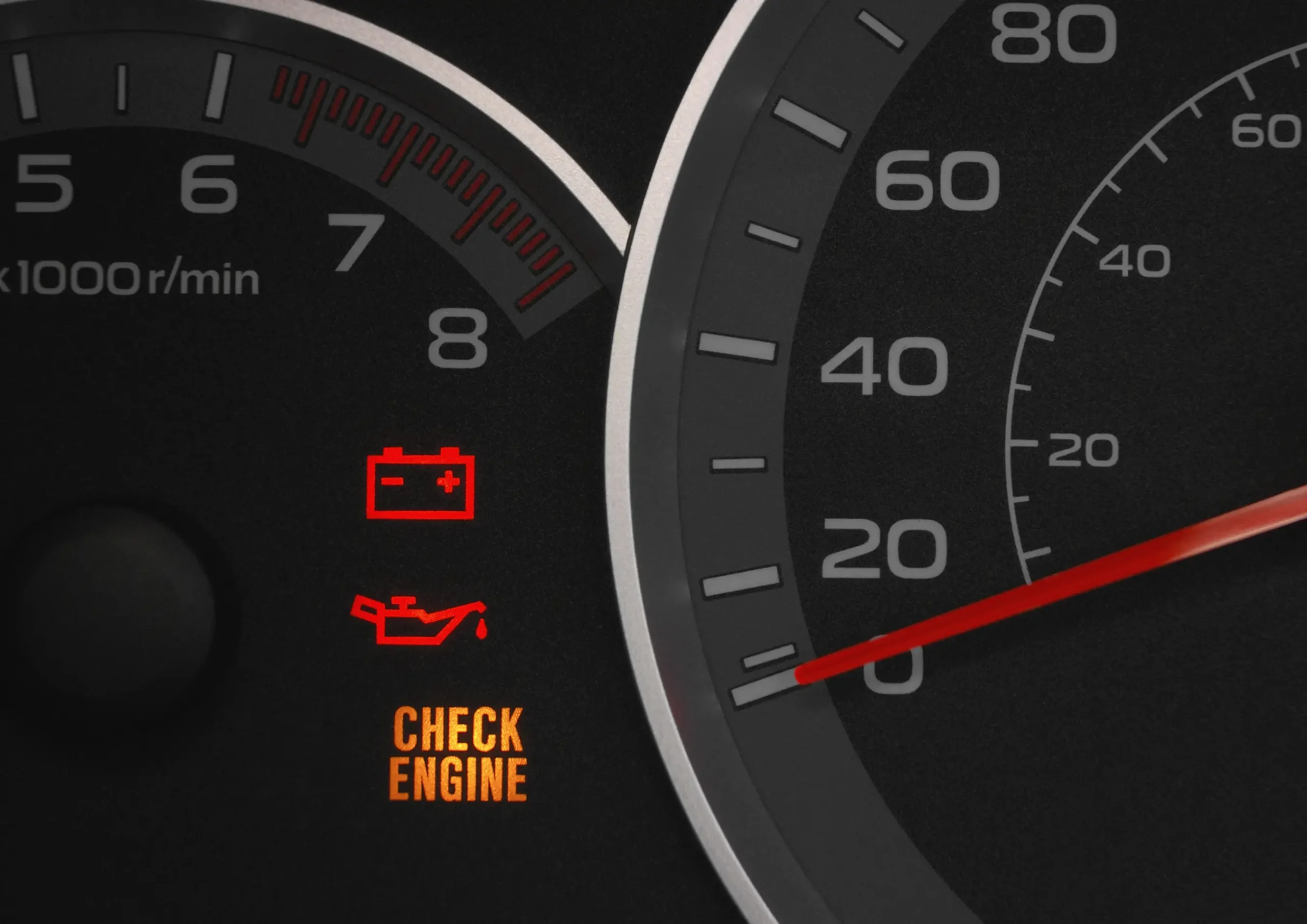
Few dashboard warnings cause as much low-grade dread as the check engine light. It’s vague by design: a small amber engine icon that could mean anything from a gas cap you didn’t tighten to a problem that will strand you on I-20. That ambiguity is exactly why so many drivers either panic or, worse, ignore it entirely.
The good news is that the light is far more readable than it seems, once you know the two things it’s actually telling you: how it’s lit, and what the car is doing while it’s on. This guide breaks down what the check engine light means, the important difference between a steady light and a flashing one, the most common causes, and what’s genuinely worth doing yourself before you have it looked at here in Lexington.
The short version: a steady check engine light means “something needs attention soon, but you’re probably okay to drive carefully.” A flashing check engine light means “there’s active damage happening. Stop driving as soon as it’s safe.” Everything else is about figuring out which specific problem triggered it.
What Does the Check Engine Light Mean? The Basics
Every car built since 1996 has an onboard computer (the engine control unit) constantly monitoring dozens of sensors: the air-fuel mixture, the ignition system, the emissions equipment, and more. When one of those readings falls outside its expected range, the computer stores a trouble code and turns on the check engine light to tell you.
So the light isn’t a diagnosis. It’s a notification that the car’s own computer has logged something worth investigating. The specific reason lives in that stored code, which is read with a scan tool plugged into the OBD-II port under your dashboard. Until someone reads the code, the light alone can’t tell you whether you’re facing a five-dollar fix or a real repair, only that the computer wants attention.
That’s the single most useful thing to understand: the light points to a stored code, and the code points to the actual problem. Everything past this is about reading that code correctly and not jumping to conclusions.
Steady vs. Flashing: The Difference That Actually Matters
If you remember nothing else, remember this distinction: it’s the one that separates “handle it this week” from “pull over.”
A steady (solid) check engine light means the computer has detected an issue that isn’t an immediate emergency. Your car will usually drive normally. It’s a signal to get the code read soon (days, not months) before a small problem grows into a larger one. Don’t panic, but don’t file it under “later” indefinitely either.
A flashing check engine light is a different message entirely. A flashing light almost always indicates an active engine misfire: raw fuel is passing unburned into the exhaust, where it can rapidly overheat and destroy your catalytic converter, one of the more expensive components on the car. When the light is flashing, the right move is to reduce speed, avoid heavy acceleration, and get off the road and to a shop as soon as it’s safe to do so. This is the one check-engine scenario that’s genuinely urgent.
A simple way to hold it in your head: steady = investigate soon; flashing = stop driving.
The Most Common Reasons the Light Comes On
While the specific cause always lives in the trouble code, a handful of culprits account for the majority of check engine lights. Knowing them helps the whole thing feel less mysterious.
- A loose or failed gas cap. Genuinely one of the most common triggers. The cap seals your fuel system, and if it’s loose, cracked, or worn, the computer detects the vapor leak and flags it. Tightening or replacing the cap can resolve it, a rare case where the fix is nearly free.
- A failing oxygen (O2) sensor. This sensor measures the oxygen in your exhaust so the computer can fine-tune the fuel mixture. A worn one hurts fuel economy and, left alone, can damage other components.
- The catalytic converter. This emissions component can fail on its own or, more often, because another unaddressed problem (like a long-ignored misfire) destroyed it. It’s expensive, which is the best argument for catching upstream issues early.
- A bad mass airflow (MAF) sensor. It measures incoming air so the right amount of fuel is added. When it drifts, you may notice rough running or poor mileage.
- Spark plugs or ignition coils. Worn plugs or failing coils cause misfires, and misfires are frequently what turn a steady light into a flashing one.
- The battery or charging system. Weak voltage can throw codes and cause odd electrical behavior, which is worth remembering in a Lexington summer, when heat is hard on batteries.
Notice a theme: several of these are cheap or moderate if caught early, but can cascade into the catalytic converter (the pricey one) if ignored. That’s the practical case for reading the code sooner rather than later.
What You Can Safely Check Yourself
You don’t need a shop to rule out the simplest cause or to gather useful information first:
- Check the gas cap. Turn off the engine, remove the cap, and re-seat it until it clicks. If that was the culprit, a steady light may clear itself after a few driving cycles.
- Note how the car feels and sounds. Is it running rough, hesitating, losing power, making new noises, or overheating? Those details genuinely help a technician narrow things down.
- Watch the light itself. Is it steady or flashing? Did it come on right after a fill-up, or after driving through deep water, or out of nowhere? Context matters.
- Don’t ignore other gauges. If the check engine light appears alongside a temperature or oil-pressure warning, treat it more seriously and stop sooner.
What’s deliberately not on this list is anything involving clearing codes or deep diagnosis, and there’s a good reason for that.
Why “Just Reset the Light” Is a Mistake
It’s tempting, especially with cheap code readers and phone apps, to simply clear the code and hope the light stays off. Sometimes it does, for a while. But resetting the light doesn’t fix anything; it just erases the notification. If the underlying problem is still there, the light comes back, and in the meantime you’ve thrown away the very information that would have diagnosed it.
Worse, clearing codes can mask a developing issue until it becomes a breakdown or a much larger repair. If the light was flashing because of a misfire, “resetting” it while continuing to drive is exactly how a manageable problem becomes a ruined catalytic converter. The light is trying to help you; erasing it without understanding why is like silencing a smoke alarm without checking for fire.
What a Real Diagnostic Scan Involves
When you bring the car in, a proper diagnostic is more than plugging in a reader and reciting a code. The code is a starting point: it tells the technician which system is unhappy, not always the exact broken part. From there, a good diagnosis interprets the code in context: the freeze-frame data captured when the fault occurred, the car’s symptoms, its history, and sometimes further testing to confirm the true root cause. In that sense it’s the reactive cousin of the regular engine inspections that aim to catch problems before a warning light ever appears.
That distinction matters because a single code can have several possible causes. Replacing a part just because it’s named in a code (without confirming it’s actually the culprit) is how people end up paying for repairs that don’t fix the problem. The value of a professional scan is the interpretation, not the plug-in, which is exactly what you’re really after when you search “check engine light diagnostic near me.”
Check Engine Light FAQs
Can I still drive with the check engine light on?
If it’s steady and the car feels normal, usually yes, but get it checked soon. If it’s flashing, or the car is running poorly, stop driving as soon as it’s safe and have it looked at right away.
Why did my check engine light come on and then go off by itself?
Often a temporary condition: a loose gas cap that resealed, or a one-time sensor reading. The code is usually still stored in the computer even after the light goes out, so a scan can confirm what happened.
Does a check engine light matter for inspections here in South Carolina?
South Carolina doesn’t currently require annual safety or emissions inspections, so an illuminated light won’t fail a state test the way it might elsewhere. But it still matters: if you plan to sell the car, register it in a state that does test, or you’re buying a used car with the light on, that amber glow is a real red flag worth resolving.
Is a cheap code reader good enough?
It’s fine for reading the code number, but the code is only the first clue. Knowing what to do with it (interpreting it correctly and confirming the actual fault) is where accuracy (and real savings) come from.
The light is on but my car drives fine. Do I really need to worry?
A car that feels fine can still have a developing problem the computer caught early: that’s the point of the system. “Feels fine” is good news, but it’s not the same as “nothing’s wrong.”
When It’s Worth Bringing It In
You can do a lot on your own: check the gas cap, note the symptoms, and pay attention to whether the light is steady or flashing. That knowledge alone will keep you calmer and better informed than most drivers when the amber icon appears. But because the light points to a stored code, and that code needs proper interpretation to become an actual answer, this is a case where a quick professional scan usually saves you money and guesswork.
If you’re in Lexington or anywhere across the Columbia Midlands and your check engine light has come on (especially if it’s flashing or the car isn’t running right), feel free to stop by Abbott’s Auto Care & Tire on West Main Street and let us pull the code and tell you what’s actually going on. We’ll read the diagnostic data, explain what it means in plain terms, and lay out your options before any work happens, so you’re deciding with real information instead of a dashboard guess. You can schedule an appointment online in a couple of minutes, or call us at (803) 356-8851, and swap that nagging little light for a clear answer.