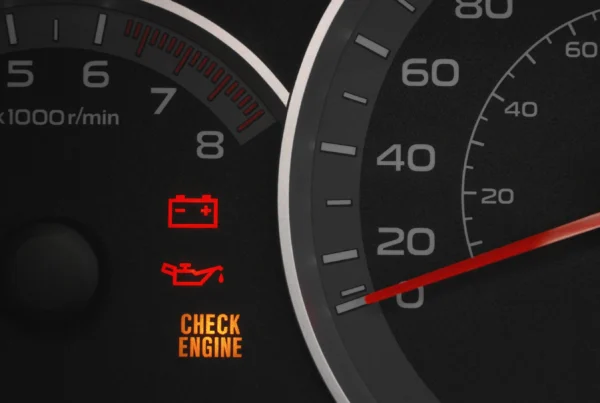

You left work in Lexington, the car fired up on the first turn of the key, and everything felt normal. Ten minutes later, somewhere on US-378 with the A/C going, a small red battery symbol lit up on the dash. Nothing sounded different. Nothing shut off. But the light stayed on.
That sequence matters more than most drivers realize. A battery that is genuinely dead does not let you start the car and then quit ten minutes later. If the engine cranked and caught this morning, the battery did its one job. What just failed is the system that keeps it topped off while you drive.
The short version
- The dash battery symbol is a charging system warning light, not a fuel gauge for your battery.
- When it comes on at speed, the alternator has usually stopped supplying the car, so everything is running off the battery.
- Four faults cause most of these: low alternator output, a failed voltage regulator, a slipping serpentine belt, and corroded power and ground connections. Only one of them is fixed by a new battery.
- Your remaining range is measured in minutes, not miles, and it is not predictable.
That symbol is not a battery gauge
The battery-shaped icon is one of the most misread lights on any dash. It does not measure how much charge is left, and it is not telling you the battery is old. It warns that system voltage has fallen outside the range the vehicle expects with the engine running.
According to Champion Auto Parts, when the charging system warning light is on, the vehicle is running solely on battery power because the alternator is no longer recharging it. The causes it lists cover the whole circuit rather than just the battery: low alternator output, a weak battery, a failed drive belt, corroded wires, loose clamps, burned fusible links, and, rarely, the vehicle’s computer.
This light is also easy to confuse with the one drivers ask about most. The check engine light means something entirely different, and it can sit on for weeks. The battery symbol does not give you that kind of runway.
So the “it started fine this morning” detail is diagnostic rather than reassuring. Starting proves the battery had enough stored energy for one crank. A battery light on while driving proves something stopped putting energy back in afterward.
What the charging system does when it is working
- The alternator is a small generator turned by the engine. Once the engine runs, it powers your headlights, blower motor, fuel pump, ignition, and every computer module, and sends the surplus back to recharge the battery.
- The voltage regulator, built into the alternator on most modern vehicles, decides how hard it works by raising and lowering its field current.
- The serpentine belt is the single ribbed belt that spins the alternator, and often the water pump, A/C compressor, and power steering pump too.
With everything healthy, a conventional charging system holds roughly 13.5 to 14.7 volts at the battery terminals with the engine running at cruising speed. That sits above the battery’s own voltage on purpose, since current only flows into a battery when something pushes it at a higher voltage. The moment the charging side falls below the battery’s level, the flow reverses and the light comes on.
The four faults behind most charging lights
1. The alternator has stopped making enough output
Alternators wear out from the inside. Output is measured right at the alternator’s output stud with the engine near 2,000 rpm, and it should read at least 13.5 volts to prove the unit can still carry the load. That measurement, not the warning light, tells us whether alternator repair in Lexington SC is the right call or whether the fault is something simpler upstream.
Failing diodes produce a partial failure rather than a clean one. A healthy alternator puts out less than 0.1 volts of AC ripple at the battery, while 0.5 volts AC or more points to failing rectifier diodes. Such a vehicle may charge just enough at highway speed on I-20 to look fine, then fall behind at idle.
2. The voltage regulator has quit regulating
A regulator can fail in the direction nobody expects: too much charging, not too little. When it sticks at full field current, system voltage climbs above 15 volts at the battery with the engine running. That overcharge cooks the battery, and it can light the same symbol as an undercharge.
3. The serpentine belt is slipping, not broken
A snapped belt is obvious, because the power steering goes heavy and the temperature gauge climbs at the same time. A slipping belt is the quiet version, and it is the one that gets missed. Slippage makes the alternator undercharge, keeps the water pump from circulating enough coolant, and can even set unrelated diagnostic codes. A glaze that forms on the belt from lost tension or pulley misalignment is what produces that high-pitched squeal on a humid Midlands morning. Since the same belt drives your A/C compressor, a belt problem can also show up as weak cooling in the middle of a Lexington summer first.
Here is the part that catches people: modern EPDM belts rarely crack with age, so a belt that looks perfect can be worn past spec. Visual inspection is unreliable on these, and a wear gauge is needed instead. Service life runs about 50,000 to 60,000 miles on older vehicles and up to roughly 100,000 miles on newer ones.
4. Corroded grounds and tired cables
This fault is the one most likely to be misdiagnosed. Fleet Maintenance quotes an industry technician on exactly this: “You’d be surprised how many people think it’s a warranty claim on a starter or alternator when it’s really just an issue with a cable.”
Corrosion also hides from the wrong test. A corroded cable or ground strap can pass an ohmmeter continuity check and still fail under load, because an ohmmeter measures continuity, not the ability to handle a high-amp current load. The right test is a voltage drop measurement: no more than 0.5 volts of drop on the charging circuit’s positive side and 0.2 volts on the negative side, with the engine at 1,800 to 2,000 rpm and the accessories on.
The electrical oddities that come with low voltage
Voltage sags as the battery drains, and each symptom is really just a module running short of volts:
- Headlights that dim at idle and brighten when you rev, the classic sign the alternator only makes usable output at higher engine speed.
- A flickering instrument cluster, sometimes with unrelated warning lights together, because low voltage sets fault codes across systems that are otherwise fine.
- A radio or touchscreen that reboots itself at a stoplight, having dropped below its wake threshold.
- Slow power windows and a lazy blower as high-draw accessories run out of headroom.
- Heavier steering or a soft brake pedal on vehicles with electric power steering or electronic brake assist, which is where this becomes a safety issue.
Two or three of those at once are one voltage problem, not three.
How far can you actually drive with the battery light on?
There is no honest mileage figure, and any article that gives you one is guessing. You are spending down a fixed reserve, and it depends on how full the battery was, its age and health, and how much you have switched on. Champion Auto Parts puts it plainly: driving with the light lit could leave you stranded, because the vehicle could stop working at any time.
Think in minutes, not miles, and buy yourself as many of them as you can:
- Switch off every load you do not need. A/C, rear defroster, heated seats, phone charging, loud audio. Keep headlights on if it is dark and wipers on if it is wet.
- Do not turn the engine off if you can avoid it. Restarting takes a large bite out of what is left, and the next start may not happen.
- Skip the extra errand. Drive somewhere safe or straight to a shop.
- Do not start a highway trip. Losing the engine in a travel lane on I-26 is far worse than losing it in a parking lot.
- Pull over immediately if the temperature gauge climbs or the steering goes heavy, which suggests the belt is gone and the water pump has stopped with it.
A jump start will often get the engine running again, but if the alternator is not charging you are back in the same spot within minutes. A jump proves nothing about the charging system.
What charging system diagnosis in Lexington SC actually involves
Good charging system diagnosis in Lexington SC is measurement, not parts-swapping, and the order of operations separates a fix from a repeat visit.
- Battery state of charge and condition first, so the tests that follow are not run against an unknown quantity.
- Charging voltage at the battery, checked against that 13.5 to 14.7 volt window, plus anything above 15 volts that would point at the regulator.
- Output at the alternator stud near 2,000 rpm, and AC ripple at 1,500 to 2,000 rpm to catch failing diodes a voltage reading can miss.
- Voltage drop tests on the positive and ground paths under load, because a bad cable and a bad alternator read identically until you measure the drop.
- Belt and tensioner inspection with a wear gauge, not just a glance.
That order avoids the outcome nobody wants: a new alternator installed, the light back on the next day, and the real fault still sitting in a corroded ground strap that passed a continuity test.
Why the Midlands is hard on charging systems
Heat, vibration, and corrosive contaminants are what wear starters and alternators out, and the Midlands supplies the first one generously. Columbia averages high temperatures of 92 degrees in June, 95 in July, and 93 in August under NOAA’s 1991 to 2020 climate normals, and under-hood temperatures run far above ambient. After the summer we just came through, this is prime season for charging faults to surface.
Batteries take the same beating. AAA reports that heat, not cold, is the number one cause of battery failure and reduced battery life, because summer heat speeds up fluid loss and oxidation inside the battery. Most batteries have a three to five year service life, and AAA’s recommendation is to test one at three years of age and annually after that. Two-thirds of Americans have never had a battery tested before it failed, and since South Carolina does not require an annual safety inspection, nobody checks the battery and the belt for you on a schedule. A heat-weakened battery and a marginal alternator produce similar complaints, and a car can easily have both.
Frequently asked questions
The battery light is on. Can I just replace the battery?
You can, and it will not help if the alternator, belt, or wiring is the actual fault. A new battery in a car that is not charging is a battery that will be flat again shortly.
Does the light mean my alternator is definitely bad?
No. It means the charging system is out of range. The alternator is the most common cause, but a slipping belt, a failed regulator, or a corroded ground produces the same warning, and each is a different repair.
My car drives fine. Can it wait until next week?
Driving fine right now is normal with this light, and it does not last. The battery is draining the entire time the engine runs, and the car can stop without further warning. At night it is worse still, because headlights are a large, non-negotiable load.
What will the repair cost?
Parts and labor pricing moves too fast for an article to quote honestly, and a stale number is worse than none. Once we know which part of the charging system is at fault, we can give you a current figure. Request a quote and we will price the specific repair your vehicle needs rather than a guess.
Get the charging system checked before it strands you
A battery light that appears mid-drive is one of the few warnings that comes with a built-in clock. Car electrical repair in the Midlands SC area starts with a short set of measurements, and they tell us whether you need an alternator, a belt, a cable, a battery, or a cleaned-up ground.
If the light is on now, or it flickered once last week and you have wondered about it since, bring the vehicle to our shop in Lexington. We will test the battery, measure charging output, check the belt and the grounds, and tell you what we found before anyone recommends a repair. Schedule an appointment and let us verify the symptom before it turns into a tow.